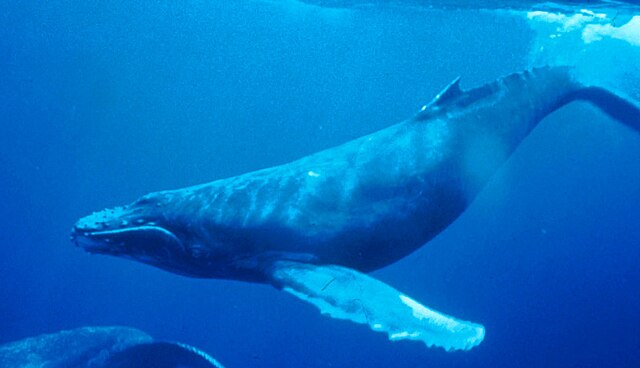
Humpback whale
Humpback whales live in all oceans around the world. They travel great distances every year and have one of the
longest migrations of any mammal on the planet. Some populations swim 5,000 miles from tropical breeding grounds
to colder, more productive feeding grounds. Humpback whales feed on shrimp-like crustaceans (krill) and small
fish, straining huge volumes of ocean water through their baleen plates, which act like a sieve.
Commercial whaling severely reduced humpback whale numbers from historical levels. The United
States listed all humpback whales as endangered under the Endangered Species Conservation Act
in 1970 and then under the Endangered Species Act in 1973. NOAA Fisheries worked worldwide to
identify and apply protections for humpback whales. The International Whaling Commission’s final
whaling moratorium on commercial harvest, in effect since 1985, played a major role in the
recovery of humpback whales. Currently, four out of the 14 distinct population segments are
still protected as endangered, and one is listed as threatened. Three humpback whale stocks in
U.S. waters are designated as depleted under the Marine Mammal Protection Act.